May 28, 2025
The Atotonilco Sanctuary: Mexico's Sistine Chapel, 20 Minutes From San Miguel
A UNESCO World Heritage Site covered floor-to-ceiling in astonishing murals, the Sanctuary of Jesús Nazareno de Atotonilco is one of Mexico's most extraordinary, and least internationally known, cultural treasures.
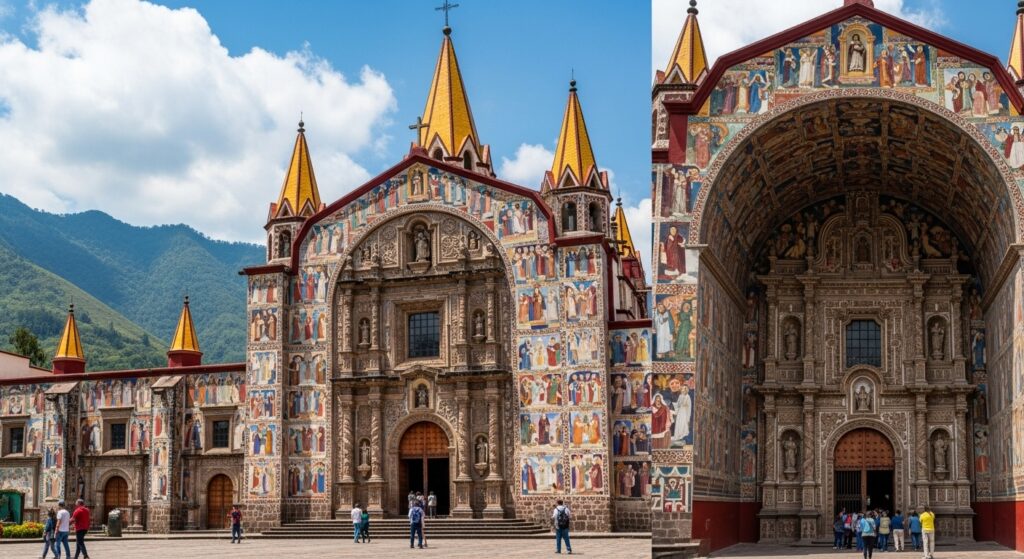
You could easily miss Atotonilco. The small town sits on a flat stretch of road about fourteen kilometers north of San Miguel de Allende, surrounded by the same scrubby, sun-baked landscape that characterizes much of the Bajío region. There's a cluster of houses, a few modest shops selling religious items, and a dusty plaza that barely hints at what waits behind the walls of its church.
Then you step inside, and the world changes completely.
The Sanctuary of Jesús Nazareno de Atotonilco is, without exaggeration, one of the most visually overwhelming religious spaces in the Americas. Every surface, the vaulted ceilings, the walls, the chapels, the arches, the domes, is covered in murals, frescoes, paintings, poems, and decorative imagery. Thousands of figures. Hundreds of scenes. Biblical narratives, saints in ecstasy, angels in flight, skulls and crossbones, floral garlands, and dense calligraphic text painted directly onto plaster. It's the visual equivalent of a cathedral organ at full volume, magnificent, disorienting, and deeply, unmistakably Mexican.
It earned its UNESCO World Heritage designation in 2008 (as part of the broader San Miguel de Allende and Atotonilco inscription), and it's often called "the Sistine Chapel of Mexico." That comparison captures the ambition and scale, but it undersells the strangeness and originality of what's actually here. The Sistine Chapel is refined Renaissance grandeur. Atotonilco is something wilder, folk art and high theology fused together in a fever dream of devotion.
The Story Behind the Murals
The sanctuary was founded in 1740 by Father Luis Felipe Neri de Alfaro, a Jesuit-educated Oratorian priest with a singular vision. He wanted to create a place of spiritual retreat and penitence, not a parish church for Sunday services, but an immersive environment designed to overwhelm the senses and shake visitors into profound religious reflection.
To achieve this, he commissioned (and likely co-directed) an extraordinary program of mural painting that would take decades to complete. The principal artist was Antonio Martínez de Pocasangre, a local painter who may have been indigenous or mestizo, his precise biography is lost to history, which makes his achievement all the more remarkable. Working with a team of assistants, Pocasangre covered the sanctuary's interior with an encyclopedic visual program that draws on scripture, Jesuit spiritual exercises, popular devotion, and Mexican folk tradition.
The result is something that doesn't exist anywhere else. European-trained painters in colonial Mexico generally followed the conventions of their era, academic composition, idealized figures, restrained palettes. Pocasangre did something different. His figures are expressive and sometimes raw. His compositions are dense to the point of horror vacui, every inch of wall space carries meaning. His color palette is earthy and local. And his text panels, painted in flowing calligraphy directly onto the walls, create a reading experience that's part illuminated manuscript, part protest banner, part prayer.
What You'll See Inside
The sanctuary complex includes a main nave, a series of lateral chapels, a camarín (a richly decorated chamber behind the main altar), and several secondary spaces, each with its own mural program and distinct character.
The main nave is where the full impact hits. Looking up from the entrance, the vaulted ceiling stretches away in a cascade of painted scenes, the Passion of Christ rendered in dozens of episodes, interspersed with angels, decorative borders, and poetic inscriptions. The overall effect is simultaneously ordered (there's a clear narrative sequence) and overwhelming (there's simply too much to absorb in a single visit).
The chapels each have their own thematic focus. Some depict the life of the Virgin Mary. Others illustrate the spiritual exercises of Saint Ignatius of Loyola, a systematized program of meditation and self-examination that was central to Jesuit education and deeply influenced Father Alfaro's vision for the sanctuary. The Chapel of the Holy Sepulchre is particularly striking, with its depictions of death, judgment, and the afterlife rendered in a style that feels almost expressionist.
The camarín, the small chamber behind the high altar, is the most ornately decorated space in the complex. It's a jewel box of color, gold leaf, and intricate painting, designed to create a concentrated burst of beauty and sacred intensity around the sanctuary's most venerated image.
Throughout, you'll notice recurring motifs that give the program its distinctive character: skulls and skeletal figures (memento mori - reminders of mortality), sacred hearts, instruments of the Passion, and dense blocks of painted text that function as visual prayers. The overall mood is intense, serious, and deeply sincere, this is not decorative painting for aesthetic pleasure. It's art created as a spiritual technology, designed to produce a specific interior experience in the viewer.
Atotonilco's Place in Mexican History
The sanctuary's importance extends beyond art history. In September 1810, at the very start of the Mexican War of Independence, Father Miguel Hidalgo stopped at Atotonilco on his march from Dolores. There, he took a banner of the Virgin of Guadalupe from the sanctuary and carried it as the standard of the independence movement, one of the most symbolically charged moments in Mexican history.
That act connected Atotonilco to the birth of the Mexican nation, and the sanctuary has carried that dual significance ever since: a place of religious devotion and a landmark of national identity. For Mexican visitors, this layer of meaning adds enormous emotional weight to the experience. For international visitors, it offers an entry point into understanding how deeply intertwined art, faith, and politics have always been in Mexico.
Visiting Atotonilco
Getting there: Atotonilco is about a 20-minute drive north from central San Miguel de Allende. The road is straightforward and well-paved. La Residencia San Miguel can arrange private transportation and, for guests who want deeper context, a guide who can walk you through the mural program's iconography and history.
What to expect: The sanctuary is an active place of worship. Visitors are welcome, but respectful behavior is expected, quiet voices, modest dress, and sensitivity to worshippers who may be in prayer. Photography policies may vary; check on arrival.
How long to spend: At minimum, plan for 45 minutes inside the sanctuary, but an hour or more is better. The density of the murals rewards slow looking. A second visit, once you've had time to read about the iconographic program, often reveals an entirely different experience from the first.
Best time to visit: Early morning or late afternoon, when the light through the windows illuminates the murals most beautifully and the crowds (mostly Mexican pilgrims rather than international tourists) are thinnest. The sanctuary is particularly atmospheric during Holy Week and the festival of the Señor de la Columna, when processions and rituals connect the present-day community to centuries of tradition.
Combine with: The hot springs at nearby La Gruta or Escondido Place are a natural complement, the contrast between the sanctuary's spiritual intensity and the gentle warmth of a thermal pool makes for a memorable half-day excursion. Several of the region's best pulque and mezcal producers are also in this direction, if you want to add a tasting stop on the return.
Why This Matters for Your Trip
San Miguel de Allende is celebrated for its colonial architecture, its art galleries, and its food scene, all of which are genuinely excellent. But Atotonilco adds a dimension that most visitors don't expect: a confrontation with the deeper currents of Mexican culture, the places where indigenous craft traditions, European religious fervor, and a ferocious creative energy collided and produced something that belongs to no other country on earth.
It's the kind of experience that stays with you long after you've returned to the cobblestoned streets and rooftop cocktails. And it's twenty minutes away.
The Sanctuary of Atotonilco is one of many remarkable experiences within easy reach of La Residencia San Miguel. The team at La Residencia can arrange private visits, knowledgeable guides, and excursions that connect the sanctuary with other highlights of the San Miguel de Allende region.
